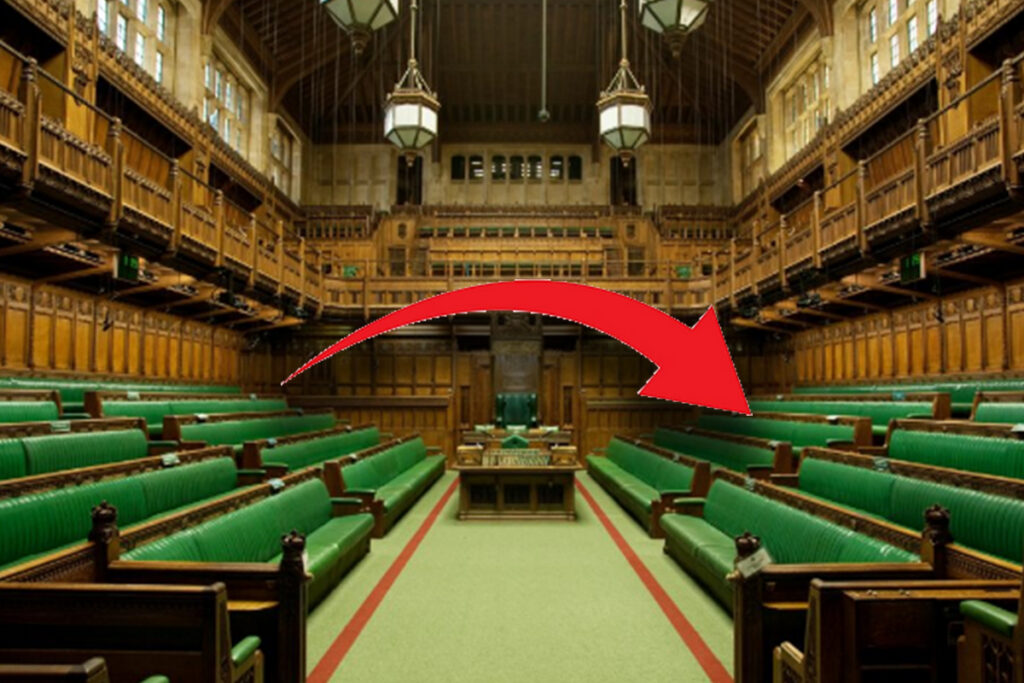
The Liberal Party inched closer to a majority government this week as Conservative Marilyn Gladu crossed the floor to join them. The move was accompanied by the usual complaints that the floor-crosser had betrayed her constituents and turned her back on the values she pledged to support.
‘Crossing the floor’, in the parliamentary system, is a term that refers to switching parties in between elections. It may happen in either direction; a member of parliament (MP) may leave the opposition to join the governing party, or leave the governing party to sit as an independent or join an opposition party.
The New Democrats have long been opposed to the practice. An NDP private members’ bill proposed in 2011, if passed, would have triggered an automatic byelection when an MP “becomes a member of a registered party” that did not endorse his or her candidacy in the election. According to NDP policy, “floor-crossers should resign their seats and allow their constituents to decide what party affiliation they want their MP to have, through a byelection.”
Of course, the NDP will also accept floor-crossers when it works for them. In Alberta, Progressive Conservative Calgary-North West MLA Sandra Jansen crossed the floor in 2016 to join the governing New Democratic Party Caucus.
The case of Marilyn Gladu is a particularly easy target, as she is anti-abortion and opposed LGBTQ+ rights. “It is outrageous but not surprising that in his drive to stitch together a majority government, Prime Minister Mark Carney is further sacrificing long-held Liberal positions on issues of fundamental rights,” wrote Leah Gazan, NDP Critic for Women and Gender Equity. NDP leader Avi Lewis said Gladu is by all accounts “a very nice person with extreme social conservative views” and her addition to the Liberal caucus raises the question of whether it’s still a progressive party.
But sometimes floor-crossing is involuntary. In the previous session, Justin Trudeau ejected Jody Wilson-Raybould and Jane Philpott from the Liberal caucus. There are usually extenuating circumstances. In 2020, the member of provincial parliament (MPP) in my own riding, Amanda Simard, joined the Liberals, having previously left the Conservatives over their stand on bilingualism. There are numerous other examples in Canadian history.
The NDP policy is consistent with a view that Parliament should be elected by proportional representation, with members selected either from a party list, or via mixed-method proportional representation. Such systems express the will of the electorate taken as a whole. If 30% of Canadians vote for the NDP, then the NDP would have 30% of the seats. Crossing the floor would obviously violate that expression of the general will.
But that is not how the Parliamentary system operates. The number of seats a party has is only minimally correlated to the total number of votes. Even with 30% of the vote, the NDP could end up with 7% of the seats. Each electoral district (or ‘riding’, or ‘constituency’) has its own separate vote. The person who gets the most votes in that system is the person who is elected (aka, a ‘first past the post‘ system).
In a Parliamentary system, the party system is secondary to the will of the electorate in individual ridings. The people elect a representative, who may, but doesn’t have to, claim affiliation in a political party. They elect the person, not the party. The person may declare a party affiliation, may declare their support for a certain set of values, and may change their mind after being elected. There is, in my view, nothing wrong with that.
(I would change the ‘first past the post’ system, though, to a mechanism of preferential balloting at the constituency level, to that the will of the people in that district is more accurately represented).
I think that the right of elected members to disagree with their parties and leaders, up to and including their ability to switch parties, is an important safety valve. It ensures that no leader is immune from losing the support of Parliament at any given time, and indeed is part of the whole reason we elect a whole body of people instead of a single person.
Even if we adopt a mixed-method proportional representation system – which I also support – the potential to cross the floor should still apply. The proportions established constitute a snapshot of the will of the public at a certain time, and that’s how the seats should be allocated, but after that, in view of any number of circumstances, we want our elected representatives to have the opportunity to change that.
The recent spate of defections to the Liberals offers a case in point. We’re living in a rapidly changing time, with global alliances shifting. In the Conservatives we have a leader, Pierre Poilievre, who has adopted a hard-right stance, and to a large degree, a pro-U.S. stance. Not surprisingly, many members do not feel they were elected to stand for such a point of view, and are uncomfortable with Poilievre’s “do as you’re told” leadership.
Meanwhile, the Liberal Party under Mark Carney has also shifted. It is popularly presented as a shift to the right, but I see it more as a shift to an economic and geopolitical focus, as opposed to Justin Trudeau’s rights-based and equality focus. They’re still Liberals, and still very distinct from the Conservative alternative. But with the parties themselves moving under them, it’s not surprising members feel they also need to shift ground.
I personally don’t care whether Marilyn Gladu has joined the Liberals. I wouldn’t have voted for her, and I definitely do not support her version of social conservatism. I can see how Mark Carney sees her as an ally, since he doesn’t really focus on social issues. And anyhow, according to their ‘official’ stance, the Conservative Party’s policy on things like abortion and conversion therapy is the same as the Liberal Party’s (though of course nobody believes they would hold to that if they had the power to change it).
But I am glad Amanda Simard left the governing Conservatives in Ontario in order to defend French language rights in the province. No, I am not French, but I believe that people should be able to be served by the government in the (official) language of their choice (long-term, I think this should be extended to all languages, but that raises a host of separate issues).
Crossing the floor is an important right our elected representatives have. It is usually a measure of last resort – members who cross the floor are rarely re-elected. It is usually a matter of principle, either getting away from something bad, or moving toward something good. It is an important mechanism that allows our governing bodies to adapt and react to changing circumstances in between elections. And the alternative places far too much power in the hands of a small group of people or even an individual party leader.
Follow this blog on Mastodon or the Fediverse to receive updates directly in your feed.

Fediverse Followers
-
-
atticusmcleod6808 @atticusmcleod6808@mastodon.social
-
 Holos Discover @HolosDiscover@discover.holos.social
 -
Flores88 @Flores88@mastodon.social
-
Tammy Manthey @tammymanthey@mastodon.social
-
kukharenkovn @kukharenkovn@mastodon.social
-
 Antonia @Antoniair@mastodon.cloud
 -
 Michael Paskevicius @mpaskevicius@mastodon.social
 -
Lauren @careslauren@mastodon.social
-
 Mark Corbett Wilson @mcorbettwilson@mastodon.social
 -
 Mark Corbett Wilson @mcorbettwilson@social.ds106.us