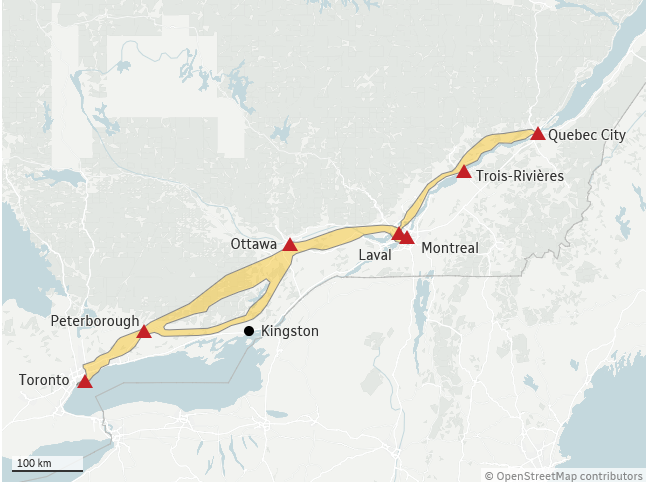
Alto for those outside the country who may not be aware, is Canada’s proposed new high speed rail system. It is intended to run from Quebec City to Toronto, though really, in my opinion, should extend all the way to Windsor.
It should not be controversial. Sure, the price tag should be controversial – how can it cost as much as $90 billion to build a railroad? Still, that number is in line with what it costs in other countries, and on a per kilometer basis, lower than many. So it costs what it costs.
Still, on Ontario Today yesterday, Matti Siemiatycki, director of the Infrastructure Institute at the University of Toronto, went on and on about the cost and how we might spend the money elsewhere. He compared it with things like local transit and existing rail. He might have a point, but he missed the most important cost: the cost of what we’re doing now with airlines and airports.
We’re looking at a $10 billion renovation to Trudeau airport in Montreal – this follows the most recent round of multi-billion dollar renovations. Toronto’s Pearson renovations– again, the latest in a series – will cost many times more. And then there are the ongoing costs of running an airline versus rail, the cost of aviation fuel versus electricity, and so on.
There’s a reason countries in Europe and Asia have deployed tens of thousands of kilometers of high speed rail over the years. It costs less to build and operate, and is more sustainable. It is also by all accounts a much more pleasant way to travel between cities. So why oppose it?
Conservative leader Pierre Poilievre cites the cost in his opposition to the plan, canning it a boondoggle. But it isn’t the cost that worries him, otherwise he would be opposing things like airports and the tunnel under the 401. No, it’s rural populism that is driving him, and we’re seeing the same sort of objections raised out here where I live.
Ultimately, the concern is that it’s a lot of money for people who live in cities, while the trains won’t even stop in our communities. It will cut through wilderness and split farms and communities apart. So we’re told. Note that the same people don’t question road improvements and expansions. The very same people opposing Alto in our region are calling for a four-lane highway following a similar route.
People want an investment that serves them. And that’s actually reasonable. Who wants to pay for a train that they have no real chance of ever using? That’s why we see support for and against Alto in different places. Peterborough, for example, which already has a four-lane highway to Toronto, is supportive. Kingston, which might be left out altogether, wants the route to be moved.
I haven’t mentioned the NDP’s contribution to the debate because the party has been almost silent, saying only that they’re worried Alto might result in the privatization of existing Via services (as though there’s anything in the existing service worth protecting). The left should be less short-sighted and reactionary. There is a strong progressive argument to be made, even if the NDP lacks the voices to make it.
Here’s what the argument should be: an investment in Alto is worthwhile only if it forms the backbone of an integrated public transportation infrastructure that reaches Canadians everywhere they live. It is absurd, for example, that the aforementioned city of Peterborough, population 147,000, has no public transportation options at all linking it to the outside world.
Canada’s public transportation system is a mess. Cities have been unable to manage transit investments. Via rail, when it does run, runs on tracks owned by freight rail, which means they cannot manage their own schedule and frequently encounter delays. Following the pullout of Greyhound, intercity bus lines have been infrequent or absent altogether.
Alto shouldn’t just be a thing in itself. A national transportation strategy, bridging investment and coordination at all levels of government, should make it possible for any Canadian to travel to any town or city, even if they don’t own a car. A national transportation infrastructure allows us to distribute people and industry across the country, instead of cramming them into increasingly unaffordable cities. Someone in Casselman, where I live, should be able to get on the train that runs through downtown and travel anywhere in the country at a reasonable speed for a reasonable price.
When we understand that transportation is a network, and not just a line, we understand how we can extend the benefits of a $90 billion investment to everyone. That’s how the left should be approaching this. That’s what we should be saying.
