The Conservative criticism of Mark Carney’s recently-signed agreement with China shows exactly why the Conservatives do not understand how to promote national interests in an increasingly uncertain world.
“Prime Minister Carney must explain how he has gone from saying China was Canada’s ‘biggest security threat’ before the election to announcing a ‘strategic partnership’ with Beijing after the election,” Conservative leader Pierre Poilievre said in a statement, as reported in this CTV article.
Quite simply, the announcement of a strategic partnership with China makes them less dangerous because it ties their interests with ours. Mutual dependence is a far more sound security posture than mutually assured destruction.
Additionally, it enhances security because it actually diffuses some of the reasons China may be perceived as dangerous. Obviously, China isn’t going to invade Canada (or Greenland, for that matter). It isn’t going to attempt regime change, or to impose its own will on Canadian internal matters.
China is pragmatically looking to develop a global network of safe and secure resources to support its continued development and prosperity. To the extent Canada recognizes and supports this aspiration, China becomes less dangerous. And – crucially – Canada’s self-interest is not sacrificed. If anything, it is enhanced.
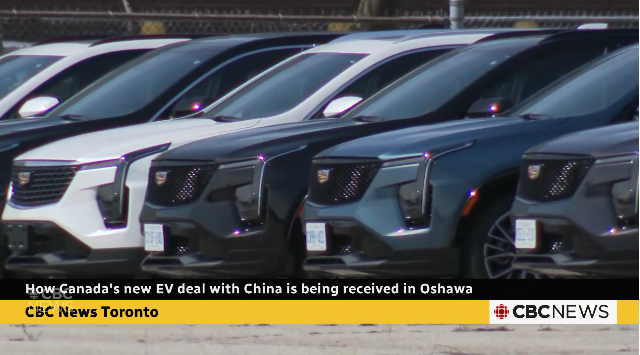
This is where we should turn to the criticisms of another Conservative, Ontario premier Doug Ford. As reported on CBC, Ford strongly opposes allowing the import of 49,000 Chinese electric vehicles (EV) at a 6.1% tariff. “By lowering tariffs on Chinese electric vehicles this lopsided deal risks closing the door on Canadian automakers to the American market.”
It’s worth noting to begin that the door is closing on the American market with or without Chinese help. The U.S. government has made it clear they would like to eliminate Canada’s participation in North American auto production entirely. If nothing else, the agreement ensures a supply of reasonably priced vehicles.
And this is an important point. American automakers have distinguished themselves recently by reneging on promises to invest in Canada, including promises to invest in the production EVs. Sales of EVs in Canada are low because it’s basically not possible to buy them. There is a demand for them – if there were no demand, importing 49,000 EVs from China would not be a threat to the auto industry at all.
According to the article, “The premier went on to call on Carney to scrap the electric vehicle mandate, harmonize regulations with trading partners, and drop federal fees that, he alleges, add to the cost of making vehicles and ‘chase away investments.'”
Ford has been no friend to those wanting Canada to pursue EVs more seriously. His first act on being elected was to cut support and subsidies for EV production. He’s happy to pay American companies to produce F-150s but draws the line at electric. It doesn’t help that he has also staunchly opposed alternative electricity production in the province as well.
More than 1.3 million vehicles were built in Ontario in 2024. In 49,000 EVs from China represents an existential threat, then the problem is not in China, it is in Ontario. Ford needs to figure out a way to move the auto industry into compliance with a worldwide desire to end dependence on oil and gas, not simply to appease his backers in the Canadian and U.S. oil industry.